Showing posts with label Rain Queen. Show all posts

Saturday, June 21, 1980

Planting Groundnuts

Lohutok, Sudan

Today, I finally saw someone scattering seeds.  They were groundnut (a.k.a. peanut) seeds, so I found out that they too are scattered on the ground before hoeing.  This is the same technique used for planting sorghum and millet.  Some of the earlier planted groundnuts are already blooming.  These will be the first groundnut crop I have ever observed as we do not grow them near my home in Kansas.  They are being planted in an area of sandy soil between the base of the mountains and the lower level of the valley.  Some people are still planting, others are weeding.
 

Above: A field before planting.

The following three photos show hoeing.  The seed was scattered immediately prior to hoeing.  Leaving the weed cover in place until the time of planting protects the soil from erosion and the sun.  The hoes have very long handles, some being longer than twice a man's height.  One might call these "push hoes".  The blade is in line with the handle, not at a right angle like hoes used in most parts of the world.  This type of hoe minimizes back strain because the user does not need to bend over.  The weight of the long handle provides momentum which helps it penetrate the soil.  It cuts off the weeds just below the soil surface while minimizing soil disturbance.  This type of hoe has results similar to the V-bladed sweep plows which are used to under-cut weeds in stubble-mulch farming systems in the semi-arid Great Plains of North America.


The following two photos show a woman piling up weeds after the hoeing operation.  If the soil were not cleared, the mulch of dead weeds would inhibit growth of the new crop.
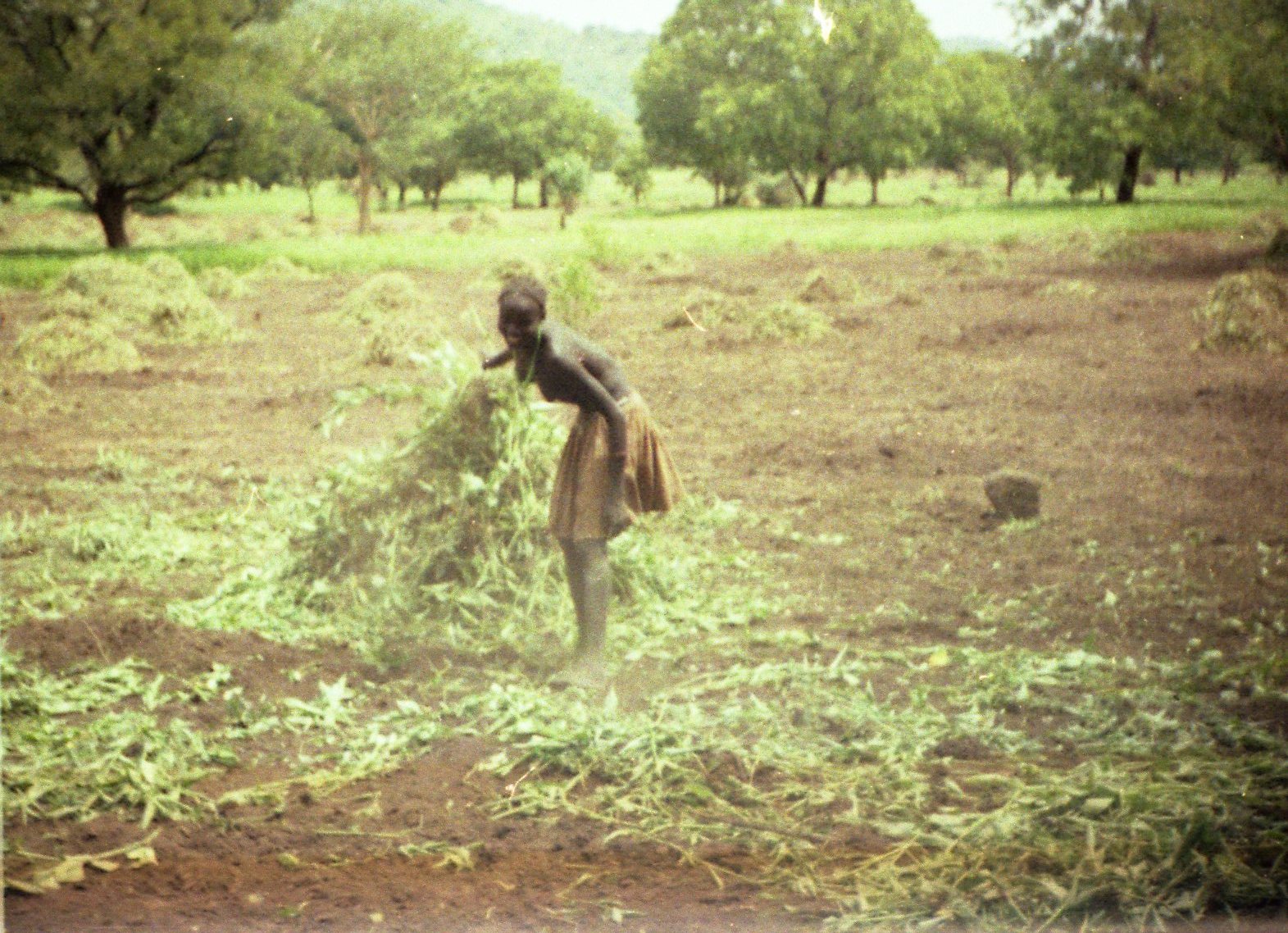


The following photo shows a newly planted field in the foreground.  Behind it, a newly emerged crop can be seen in a previously planted field.  The slopes of the Lopit mountains are visible beyond the fields.


[Disclaimer:  The above photographs are representative of the process of planting groundnuts, sorghum and millet.  They were not necessarily all taken at the same time or location.]
 
I saw Adelino today.  He was weeding and transplanting some sorghum into spots where none was growing.  His wife was just coming to help when I arrived.  Some of the plants he was pulling looked to me like sorghum.  I thought he was thinning his stand.  I pointed to a plant he had pulled and said it looked the same as the ones he was leaving, expecting to get a response about thinning.  But he said it was a weed and held it up next to a sorghum plant so I could see the difference.  I could see no difference, but shrugged in agreement so as not to seem as ignorant as I was.
 
Samuel got back from Torit late this afternoon.  He said there was no grain available for sale.  I imagine the local people who rode along to get some were quite disappointed.  It is a very sad thing if this means food is running out.
 
I read the remaining chapters of Agriculture in the Sudan by Tothill.  I started reading The Mountain People by Colin M. Turnbull.  The author's anthropological approach seems similar to what I find myself doing here.  He has problems that I can understand, e.g. getting straight answers to one's intended questions, language barriers, unintentionally biased guides and people who are looking for gain from you.  He seemed to find a conflict between blending into the culture and collecting information.  Apparently there was contact between the subjects of his study (the Ik in northeast Uganda) and the Taposa of southeast Sudan.
 
There was a very good rain last night and this morning.  Thobias told me the people in the village quarreled with the rain queen yesterday and apparently threatened to send her off.  I hope this bodes well for Christ's cause here.  I was not able to understand the details about the quarrel with the rain queen.

I started some serious language study today.  It seems slow.  Language study always seems slow.  I will almost certainly end up giving talks at clinics or church.  I am going to listen to Janice give one first so I get a feel for the appropriate communication "level".

Saturday, June 14, 1980

Visit to the Mountain Field

Lohutok, Sudan

Thobia took me to one of the mountain fields today. He went to Uganda during the war. He speaks fair English. He seems to have had a fair amount of education and would like to get more. His texts and other books were stolen in Torit, which is why he must wait to continue his education.

The sorghum in the mountain field looked good. Most of it was from knee-high to hip-high. The soil was a loamy texture and had some moisture in it. The field is situated in a concave area (or trough) which runs down the mountainside. There is a ditch of sorts down the center of the field. The field is very steep relative to the plain below and the trough is also very steep from side to side. This was the first year the field was planted. The first step in preparation was to cut down the trees in February. These were allowed to dry for a month, then they were burned. Rocks and logs seemed to be placed on the contour in a sort of terracing system. Some were not placed on contour but up and down the slope to demarcate property lines.  Or maybe they mark garden boundaries rather than ownership. I do not yet know much about the ownership system. The fields were fairly free of weeds in general. He said that after the planting of the lowland sorghum, the mountain fields would be weeded. Brown or red sorghum is grown on the mountains and white sorghum in the valley. The white sorghum (millet?) is better to eat according to Thobia. I want to visit a field which has been production for several years for comparison purposes.

Above: Thobia standing in the mountain field.

Below: These two photos show sorghum growing in the mountain field. 


Below: The steepness of the field is evident in this photo taken later in the growing season. 


Thobia pointed out many trees along the way whose seeds are used for food. There is one tree whose seed is used for oil. The leaves of another tree are used as a vegetable. We saw some children picking a plant which is used as a vegetable.

There were notches cut in some trees. If I correctly understood, this was to see if they were hollow and therefore usable as beehives. The beehives were made from logs which were hollowed out. These seemed to be at least partially capped and hung in the trees. I wonder how they harvest the honey without being stung? He also showed me an old trap used for catching animals. It (or what was left of it) consisted of some stones stood on edge in an open-ended rectangle. Apparently when a monkey, or perhaps even a leopard, goes inside, something (a rock?) falls on him and crushes him.  (It was not always easy to overcome the language barrier.)

There were two people at the mountain field to scare monkeys away. Monkeys pull up the sorghum. One person was assigned to each side of the field. The field was quite large, so this was not a large use of manpower. I think the field may have been twenty acres in size. (That's a guess from my memory. I did not make an estimation while at the field.)

Below: A boy guards the field from monkeys.  Birds will also be a problem after the grain forms.


On my way down the mountain I was talking with Thobia. He seemed to want me to get him some shoes. He also wants to see some textbooks. He wanted me to see if the others would bring tea and sugar to him and the other Lotuko men who work here. I am not sure how to handle such requests. I wonder about what my goal should be in helping these people materially. Clearly their level of living should be higher. But I would not want them to be cursed with the materialistically high level of living of the U.S. Maybe this isn't the right question. It is the attitude toward wealth rather than wealth itself with which a Christian ought to first concern himself.

Martha was talking last night about how many people are hungry this time of year. (She said Hans says it is because they sell their grain earlier in the year and have to buy it back later.) I ought to ask her to collect statistics about health status or weights of people who come to the clinic. It would be a useful addition to my thesis.

Samuel and Christine told me tonight that there is a rain queen in Lohutok. Her husband the rain king died a few years back. It is claimed she can make it rain or withhold rain. They say that she really seems to have that power. It is so easy for us to forget that we are in a real spiritual battle. I guess it becomes a bit clearer around here. We need to pray that God will display his power over the rain queen.