Showing posts with label Farming System. Show all posts

Saturday, July 19, 1980

A Monkey Trap

Lohutok, Sudan

The plane left this morning.  After that, I walked up the valley to our west.  I walked for a ways up the dry, sandy stream bed.  As the stream got rockier, there was water babbling through it.  Parts of the stream were quite pretty with boulders and rocks, pools of clear water, small waterfalls, tiny rapids and grass and trees overhanging the bank.  After about forty-five minutes of walking, I came to the mountain gardens near the head of the valley.  The place seemed drier and sandier than Ahaba.  There was quite a bit of ometi (bullrush millet) mixed in with the osingo (sorghum).  I walked up to a small hut built up in one of the lower fields and said "mong" (a Lotuko greeting) to the young girls who were there.  I always get amusing reactions when I do that.  They were cooking some angiria (sorghum porridge).  I climbed up a rock for quite a ways.  People in some of the fields below me were playing flutes, pounding a drum and singing.

I saw a monkey trap made from a rock, sticks, bark string and a bit of sorghum used as bait.  The following sketch of the trap is my best attempt, but is not quite accurate.  I am not a very good artist.  If the monkey pulls the sorghum, the sticks propping up the rock fall allowing the rock to tumble and pin the monkey's arm.


I saw a young man and woman on a rock in the shade near a sorghum field.  They were talking and smiling.  It was the closest thing I have seen to romance so far.  The man was eating some holé  (or ahulé?) and gave me some to try.  It was a clearly a cucumber, but much shorter and chunkier than the ones we have in the U.S.A.

This afternoon, Martha, Marcia, Brian and I walked over to Lohofan.  This is the place to our east which reminds me of Buttermilk Falls in Ithaca, New York.  (There is photo of this area  at my blog entry dated June 27, 1980.)  I should mention that Brian Arensen is Lanny's younger brother.  He is  here on a short visit.

Thursday, July 17, 1980

Slaughtering a Goat

Lohutok, Sudan

I went up to Ahaba, the mountain field, this morning.  The sorghum is looking good.  Much of it is starting to head.  I saw a pumpkin which is already about the size of a muskmelon.  (Some pumpkins were planted among the sorghum plants.)  There was a man up at Ahaba who is already cutting trees for a garden for next year.

AIM missionaries David and Joanne Gladstone came to Lohutok for a visit.  They drove a Land Rover pickup.

We slaughtered a goat today.  It was the first time I have seen the throat of a live animal cut.  The blood really spurted from the jugular veins.  On second thought, it is not quite true that this was my first time seeing an animal's throat cut.  We often cut the heads off chickens on our farm in Kansas.  Somehow, killing a chicken seems less disturbing than killing a goat.  Perhaps this is because I am more closely related to goats which are fellow mammals.  Perhaps it is because the goat's death was a little slower and drawn out than the sudden demise of our chickens.

The Diguna missionaries got the pipe put in the well for the new windmill today.  I helped a bit.

I wrote letters to Mom and Dad and to a friend today.  Letter writing is always a last minute task before the plane comes.

Wednesday, July 16, 1980

Norwegian Church Aid (NCA) Agricultural Project

Torit & Helio, Sudan

We went to Helio (near Torit) where I saw one of Norwegian Church Aid's (NCA's) agricultural people.  There was also a young woman there from Yambio Agricultural Institute.  She was with NCA for some sort of practical training.  NCA is working with oxenization and with improved seeds such as the sorghum variety Serena which Josiah planted.  NCA works primarily with improved simsim (sesame), sorghum, groundnuts and cassava.  They do not do the breeding, but test seeds in connection with government research and multiply planting stock.  They have a very good looking variety of cassava which seems quite resistant to cassava mosaic.  I was not able to evaluate the groundnuts or sorghum I saw as they were still in an early growth stage.  NCA inter-planted cassava and groundnuts in one of their plots.  I would like to try the improved cassava in Lohutok and perhaps encourage its being planted just before fallowing on the appropriate soils.  That might extend the cropping life of a given field, complement seasonal bottlenecks, provide a famine relief store and encourage the rapid regrowth of woody vegetation.

Photo: Sesame Plants in NCA Test Plot

Photo: Cassava and Groundnuts Inter-Planted in NCA Test Plot

NCA also has nurseries for trees (e.g. mango, orange, guava) which they want people to plant in the villages.  They have Rhode Island Red chickens (better egg layers) for crossing with local types (better brooders).  They have some ducks around their station.  They have cotton spinning, weaving and sesame oil processing as part of an appropriate technology program.

Photo: Spinning Cotton - NCA Appropriate Technology Project

Photo: Seedlings in NCA Nursery

We may have the Lohutok cooperative set up so we can get grain tomorrow.  The man we needed to see was out, but Josiah is staying over to see him in the morning.  A lorry will be bringing grain this way in the morning.  Josiah hopes to be able to come on that truck.  Hopefully we will be able to get that grain at cooperative price.

Torit has a market section which I did not get to look at closely.  Torit also has an area with quite a few "modern" buildings (government offices, hospital, aid agencies, etc.)  The residential section consists of typical Lotuho mud huts with grass roofs.

Observation of Soils Along the Lopit Mountains

Torit, Sudan
  
We travelled to Torit today.  The trip along the Lopit Mountains more or less confirmed my initial ideas about the soil catena.  I drew the catena as follows.  I have noted the typical agricultural use of each soil type as well as its normal natural vegetation.

Sketch of Generalized Soil Catena
Lopit Mountains, Eastern Equatoria, Sudan

I think there are quite a few places without a broad alluvial valley.  In these places, the red sandy soil generally grades into the drier soils of the plains.  Perhaps I am not detailed enough about the soils of the plains or need to subdivide them further.  I think that these soils range from sandy to darker clay.  Some areas are well drained others quite flat.  I have not had opportunity to carefully observe the soils further from the mountains and figure out crop-soil associations for them.   The road, poor as it is, runs along the mountains.   There are no roads further from the mountains.

Thursday, July 10, 1980

Additional Information About Crops

Lohutok, Sudan

I went to the mountain garden, Ahaba, this morning.  There are still very few weeds and little weeding has been done.  Low weed pressure is apparently one advantage in the first year after clearing trees in the mountains.  Some of the tall sorghum is heading.  Some of the maize (corn) is tasseling and looks very good.  Much of it has two ears per stalk though the ears are quite a bit smaller than we would expect in the United States.
  
My house is off to a good start at its new site.  Lanny decided it would be better if it were closer to the other houses, so we moved its location.  Samuel is putting tin on his roof today.

Photos: Construction on my house begins.


I talked with Tobia today.  I got the names of more types of sorghum and groundnuts.  I added them to my entry of Tuesday, 8 July 1980.  I will repeat the new information here also.
  
Red Sorghums:
Akunati - Tall, red, goose-necked.
Obilet - Tall, red.
  
Groundnuts (peanuts):  
Atuye - Bush type.
Elonge - Bush type. Very big brown nuts. Must be dug to harvest.
Logum - Bush type.  Like atuye, but big nuts.
Aheto - Bush type.  White nuts.  Many nuts in each shell.
Amakarara - Big shell like kabir.  Bush type.  Must be dug to harvest.
  
Maize (corn):
Etuyet - A type of oseri which is short and has one-ear.
  
Refer to the Tuesday, 8 July 1980 entry for a more complete list of crop varieties.
  
Tobia said some groundnuts must be dug with hoes while others can just be pulled.  The types which must be dug are elonge, amakarara, kabir and aful.  Tobia planted aful and atuye this year.  He had no seed for amilo as his was destroyed by the sun last year.  Amilo is planted about 2 weeks after other groundnuts.  The things he said about it seemed to indicate that it is less drought tolerant or else photoperiod sensitive.

One would expect that with so much variation to work with, crop breeding programs would have a good chance of success with sorghum and with groundnuts.

Tuesday, July 8, 1980

Cultivars of Sorghum, Groundnuts, Millet and Maize

Lohutok, Sudan
This morning, I helped Samuel with getting the rafters onto his house.  I also watched a bit as they began putting poles up for my hut.
  
Photo: Samuel installing rafters
  
I talked with Michael and asked him about the spelling of Lotuko names for crops.  Emma is a general term for grain.  I initially learned there are at least eight types of sorghum, four types of groundnuts and one or two types of millet and one type of maize (corn).  In later conversations with Michael and others, I learned of still more types.  They are as follows:
  
Red Sorghums:
Osingo - A general term or a specific type.
Ngirengire
Aderi
Tuhunyi - Short, earlier-maturing than osingo.
Akunati - Tall, red, goose-necked.
Obilet - Tall, red.
  
Brown Sorghum:
Okoro
  
White Sorghums:
Odoko
Ameterita - "Dura" can be a general term or can refer to this variety.
Ngaboli - Off-white or yellowish in color.
  
Groundnuts (peanuts):  
["Ful" is the general term for groundnuts.]
Kabir - Big, long shell, bush type.  Must be dug to harvest.
Anguak - Bush type.  Michael said it has numerous small nuts, but Otia said they are big.
Amilo - Red nuts, many nuts in each shell. Plant 2 weeks later. Destroyed by sun in 1979.
Aful - Vine type.  Has been used since time immemorial.  Must be dug to harvest.
Atuye - Bush type.
Elonge - Bush type. Very big brown nuts. Must be dug to harvest.
Logum - Bush type.  Like atuye, but big nuts.
Aheto - Bush type.  White nuts.  Many nuts in each shell.
Amakarara - Big shell like kabir.  Bush type.  Must be dug to harvest.
  
Millets:
Ometi - Bullrush or pearl millet.
Faloro - Finger millet.  Seldom grown.  Maybe planted by only one person in Lohutok.
  
Maize (corn):
Oseri
Etuyet - A type of oseri which is short and has one-ear.
  
Michael said odoko (a white sorghum), ngirengire (a red sorghum) and ometi (bullrush millet) can be planted together.  Of the groundnuts, anguak (a bush type) and aful (a vine or spreading type) can be planted together. 

Saturday, July 5, 1980

Interviewing Josiah About Lotuko Agriculture

Lohutok, Sudan
 
It rained most of the morning and some of the afternoon.  I read the rest of the CIMMYT publication about rapid surveys for planning agricultural innovation or research.  It motivated me to start structuring what I am doing.  I need to get crackin' on a thesis outline revision and some tentative ideas for a formal survey.
 
I talked to Josiah this afternoon.  Tomorrow they are going to have a meeting after church to form a cooperative for buying grain.  The grain can be purchased from Equatoria Trading Commission which is headquartered in Juba.  The grain can be purchased in Juba for 15 Sudanese pounds or in Torit for 22 pounds.  That compares with the merchants' price of 30 or 36 pounds.
 
Josiah told me that there is no person in authority who allocates the gardens.  Apparently, for the mountain gardens, a group of people decide they will make gardens in a certain place.  If someone wants to go along with them, he can.  They then, as a group, decide the boundaries of each person's garden.  Josiah says that there is plenty of land.  I guess that is why there can be such an informal arrangement for deciding who gets what and how much land.
 
According to Josiah, there is shifting cultivation out on the plains as well as the mountains.  That makes sense.  In the valley, cultivation is continuous.  On the mountains, fields can be farmed for 2 to 4 years with a 10 year fallow.  On the plains, fields can be cultivated for 3 to 6 years with a 15 or maybe 20 year fallow.  Weeds are the problem which necessitates rotating to fallow on the plains.  Weeds are not so big a problem on the mountains.  This I have observed.  I wonder why the cultivation period and the fallow period both are shorter on the mountains?  Faster nutrient cycling?  More rain?
 
There are 7 clans in Lohutok by Josiah's count.  A given clan does not live in a particular village.  Neither do village or clan divisions determine who goes together to clear a garden such as on the mountain.  One can only marry someone from a different clan.
 
Cattle, goats, sheep and chickens are owned individually.  Some people apparently have quite a few cattle and goats while others have few or none.  During the civil war, the Arabs and Taposa took or killed the animals.  Since then, the herds had to be built up from nothing.  When someone accumulated enough money he could perhaps buy a goat.  That is how the recovery began.
 
I get the impression that there are gender roles but that they are not strictly adhered to.  Hoeing the gardens tends to be done by men but women also hoe.  The women tend to be the ones who gather the weeds into piles if my observations are representative.  When planting is done with communal labor, it is the owner and his best friend and their wives who gather the weeds into bunches according to Josiah.  It is very important to take up all the weeds so they do not regerminate or prevent the crop from starting by smothering it.  (Apparently this is not true in some areas of the Imatong mountains.)  Weeding may also be done collectively.  For collective labor the owner of the garden must provide food and beer.  Weeding tends to be done by women but I have seen many men do the weeding also.
 
During school hours, children who do not go to school guard crops from monkeys and birds.  The children who go to school are supposed to relieve them by guarding the crops after school hours.  If all children went to school, I do not know how this job would get done.  It is not uncommon for a family with 4 children to put 2 in school and keep 2 at home to work.  Compulsory eduction and crop protection could be very conflicting goals.
 
Josiah said that perhaps three-fourths of the farmers have mountain gardens.
 
Josiah mentioned rural-urban migration as a contributing factor in the food shortage.  The drought was the main factor.  The rains did not fall much from July to October.
 
School vacation is from December to April which is the hot dry season.
 
Josiah said it could be difficult to get many people into a cooperative because they are not educated.  They might think the government should give them grain or that the government was taking their money to use for other projects.  This could hold a lesson about the feasibility of a credit program or herbicide and fertilizer programs.  The people might have difficulty understanding and implementing them.

Tuesday, July 1, 1980

Construction of My Hut Begins

Lohutok, Sudan
 
This morning I drove Martha to the clinic in Lalanga.  Once again I collected weight information for the children.  I noticed that the few who came both weeks are those in the poorest health.  The clinics are intended to help the children stay healthy, so I was expecting that those who came regularly would be the ones in the best health.  But apparently what is happening is that only those most acutely in need of medical care are repeat attenders.  The others do not come regularly.  One wonders how effective the malaria prophylaxis (Maloprim) is under such conditions.  Martha gives Maloprim to all the children who come, but it is supposed to be taken weekly.

Samuel and I finished another rafter (#4 of 6) today.  Six or seven men began work on my hut today.  I saw that they have some poles made for it.  It will be rectangular rather than round as I originally thought.  That is mainly so that things such as a bed will fit in it more easily.

Photos: My hut under construction
(Actually taken on a later date)


I thought I saw groundnuts and sorghum interplanted just east of where the side road to Lohutok intersects the main road.  They were on the south side of the road.  I could not tell for sure from the Land Rover.  I will have to walk down there and have a look sometime.

Thursday, June 26, 1980

Thoughts on Materialism; Observing Crop Conditions

Lohutok, Sudan

This morning, I was to take Martha to a couple of clinics to give vaccinations. It rained, so we dared not venture forth on the muddy roads. Instead I stayed around here and read. I finished The Mountain People which is about the Ik tribe of northeastern Uganda. I understand they are similar to the Taposa of southeastern Sudan and the Turkana of northern Kenya. It was sad to read that the Ik's society degenerated to an "every man for himself" one and continued along that path even when there was enough food for everyone. The author said this should teach western society to pursue social values, not just what Francis Schaeffer would call "personal peace and affluence". I think it is true enough that selfish materialism will be the undoing of western society. But I think it will take more than an appeal from an anthropologist to prevent that. Man will have to turn to God for individual healing before society can be healed.

I went on a long walk today, perhaps four miles. Quite a few of the sorghum and millet fields (called "gardens" by the local people) were heavily weed infested. But other fields looked as good as I would expect to see in a fairly typical Kansas field except for uniformity of size. Uniformity may not even be considered a benefit here. Uniformity is necessary for mechanized agricultural operations. But where crops are harvested by hand, a labor bottleneck might be created if all the plants in a field matured at the same time. Planting multiple varieties in a field may also reduce the risk that any one disease, insect or other disaster could wipe out the entire crop.

I saw Abele and Kelero Onuha who were planting across from the school. They are going to plant a strip of local millet next to a short season, short statured cultivar they got from Norwegian Church Aid's project in Torit. Josiah's plot won't be the only one planted to this cultivar. I hope this high yield variety (HYV) does not need fertilizer and special treatment to do well.

There are some maps available in Khartoum for this area showing topography and quite a bit of detail. Hopefully supplies last. I saw a fairly good magazine called Sudanow. I ought to check whether Cornell University gets it.

Saturday, June 21, 1980

Planting Groundnuts

Lohutok, Sudan

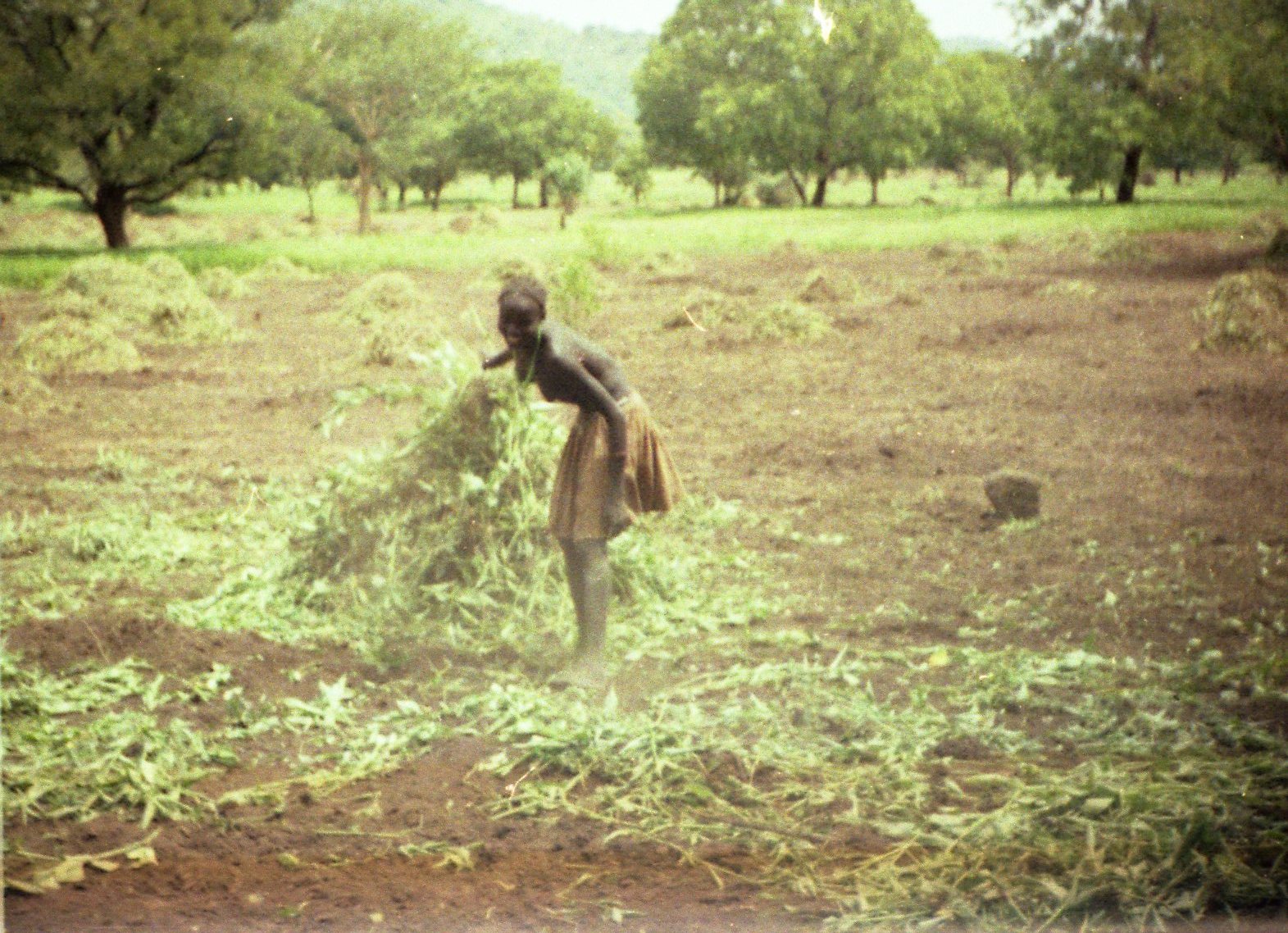
Today, I finally saw someone scattering seeds.  They were groundnut (a.k.a. peanut) seeds, so I found out that they too are scattered on the ground before hoeing.  This is the same technique used for planting sorghum and millet.  Some of the earlier planted groundnuts are already blooming.  These will be the first groundnut crop I have ever observed as we do not grow them near my home in Kansas.  They are being planted in an area of sandy soil between the base of the mountains and the lower level of the valley.  Some people are still planting, others are weeding.
 

Above: A field before planting.

The following three photos show hoeing.  The seed was scattered immediately prior to hoeing.  Leaving the weed cover in place until the time of planting protects the soil from erosion and the sun.  The hoes have very long handles, some being longer than twice a man's height.  One might call these "push hoes".  The blade is in line with the handle, not at a right angle like hoes used in most parts of the world.  This type of hoe minimizes back strain because the user does not need to bend over.  The weight of the long handle provides momentum which helps it penetrate the soil.  It cuts off the weeds just below the soil surface while minimizing soil disturbance.  This type of hoe has results similar to the V-bladed sweep plows which are used to under-cut weeds in stubble-mulch farming systems in the semi-arid Great Plains of North America.


The following two photos show a woman piling up weeds after the hoeing operation.  If the soil were not cleared, the mulch of dead weeds would inhibit growth of the new crop.


The following photo shows a newly planted field in the foreground.  Behind it, a newly emerged crop can be seen in a previously planted field.  The slopes of the Lopit mountains are visible beyond the fields.


[Disclaimer:  The above photographs are representative of the process of planting groundnuts, sorghum and millet.  They were not necessarily all taken at the same time or location.]
 
I saw Adelino today.  He was weeding and transplanting some sorghum into spots where none was growing.  His wife was just coming to help when I arrived.  Some of the plants he was pulling looked to me like sorghum.  I thought he was thinning his stand.  I pointed to a plant he had pulled and said it looked the same as the ones he was leaving, expecting to get a response about thinning.  But he said it was a weed and held it up next to a sorghum plant so I could see the difference.  I could see no difference, but shrugged in agreement so as not to seem as ignorant as I was.
 
Samuel got back from Torit late this afternoon.  He said there was no grain available for sale.  I imagine the local people who rode along to get some were quite disappointed.  It is a very sad thing if this means food is running out.
 
I read the remaining chapters of Agriculture in the Sudan by Tothill.  I started reading The Mountain People by Colin M. Turnbull.  The author's anthropological approach seems similar to what I find myself doing here.  He has problems that I can understand, e.g. getting straight answers to one's intended questions, language barriers, unintentionally biased guides and people who are looking for gain from you.  He seemed to find a conflict between blending into the culture and collecting information.  Apparently there was contact between the subjects of his study (the Ik in northeast Uganda) and the Taposa of southeast Sudan.
 
There was a very good rain last night and this morning.  Thobias told me the people in the village quarreled with the rain queen yesterday and apparently threatened to send her off.  I hope this bodes well for Christ's cause here.  I was not able to understand the details about the quarrel with the rain queen.

I started some serious language study today.  It seems slow.  Language study always seems slow.  I will almost certainly end up giving talks at clinics or church.  I am going to listen to Janice give one first so I get a feel for the appropriate communication "level".

Wednesday, June 18, 1980

More Information About the Farming System

Lohutok, Sudan

The plane came in today with Janis Arensen and her two young daughters.  It also brought mail.

I went up to the village yesterday to ask Daniel about whether there is any way to get grass for a roof for my hut.  He said no.  I talked with him for quite a while.  He says the people have developed an ingenious system for storing grain.  They put the grain in raised structures and seal it with a mixture of ash and dung.  Large flat stones are also used.  This is to prevent insect entry.  DDT insecticide may also be used if it can be purchased.

I asked about the cultivation of the mountain fields.  He said tree cutting begins in October and goes perhaps through December.  It dries in January and is burned in February.  Heavily tree covered areas are selected for fields.  A field will be used for two years or four years if particularly fertile.  Then it is allowed to go back to forest.  It requires about 20 years before a field is ready to be cultivated again.

People will often "hire" others to help with their planting and weeding.  They pay the workers by supplying their food.  Daniel had 81 people, men and women, helping with his planting one day.  Weeding is done by women who are 18 years old and older and by the old men.  I think I should wait to do a labor survey until I further clarify how labor use is related to gender roles, communal work, etc.

I have begun thinking that an oxen mechanization program might eliminate the communal labor.  That could be a bad thing, especially if people enjoy working together and if it breaks down community spirit.

Daniel gave me the names of several plants used for food.  These included cassava, papaya, pumpkin, sweet potato, okra, mulé (from a tree) and amagwé (which has leaves like a groundnut).  I guess when weeds are hard to control, these people find ways to make use of them.  It would be a great addition to my thesis if I could put together a long list of plants used for food, fiber, etc.

I learned the names of the mountains around Lohutok.  The biggest one is called Lodyo.  It has a rock cliff at the peak.  The main village is at its base.  The one with a triple peak is called Asarahai.  The missionaries refer to it as "Three Sisters".  Others are called Sohot (smaller peak near the mission station) and Lolyiri.  The mountainside valley where the big field is located is called Ahaba.

Above:  Lodyo, on the right, is Lohutok's highest mountain.  Asarahai, on 
                the left, is also known as "Three Sisters" because of its three peaks.

Cassava is planted one year, then it is harvested and planted again in the same month a year later.

Daniel said that not all of the Lotuko live along the mountains as those at Lohutok do.  Some live near the main road.  He was referring to the road which runs from Torit to Kapoeta.  But he said that more than half of them live along the mountains.  He thinks there are between 15,000 and 25,000 Lotuko altogether.  That should that between 7,500 and 12,500+ people have farming systems very similar to the one here.

Monday, June 16, 1980

Welding and Learning About Gender Roles in Farming

Lohutok, Sudan

I wrote to Pastor John and Ruth Wilkens of Brantford Covenant Church in Kansas.  I asked them to show their letter to Delbert and Pearl Anderson.  I also wrote to Dave Ettestadt, a grad student in Physics at Cornell.

Last night, my stomach was rather uneasy and I had some diarrhea.  It was minor and seems to be gone now.  Samuel is still fighting something he came down with yesterday.  It may be malaria.  Malaria used to be a frightening word.  With modern medicine, it is not much different than the flu (except that it can recur).

I saw a guy walk past this morning with an automatic rifle.  Interesting!  A hold-over from the latest civil war I suppose.  Or perhaps it came out of Uganda.

I helped Samuel do some welding this afternoon.  It was a bit frustrating as the welder quit working part way through.  Its habit is to quit when it gets warmed up.

A guy named Ernes (spelling?) stopped to see what we were doing.  He said he was finished planting today.  He said weeding will start next week.  He said the women do the weeding.  "Men cannot weed", he said.  I tried to ask what the men do.  I think I understood him to say that men sit around and / or they will dig or plant cassava.  This opens up a whole new set of questions about who does what and will complicate any labor use studies.  Oh well, farming systems in less developed countries are supposed to be complicated.  I also see I have not gotten complete answers about what crops are grown.  I wonder if cassava is used as a famine reserve crop?